Overview
Obesity and type 2 diabetes are becoming more common, and both conditions increase the risk of developing clear cell renal cell carcinoma (ccRCC), the most common form of kidney cancer. The earliest genetic changes that lead to this cancer can happen many years before the disease forms, which means there is a long window in which prevention may be possible. Our research has shown that kidney cells carrying these early genetic changes rarely grow into cancer on their own. This suggests that outside influences—such as diet—play an important role in whether cancer develops. Recent studies in mice found that an unhealthy high-fat diet makes these vulnerable kidney cells more likely to grow and form tumours.
Our goal is to understand how diet and obesity change kidney biology in ways that allow these vulnerable kidney cells to cause cancer. By understanding the biological changes that link diet and kidney cancer, this research will help us better understand populations at higher risk of developing ccRCC and find new ways to prevent ccRCC before it starts.
Scientific Focus
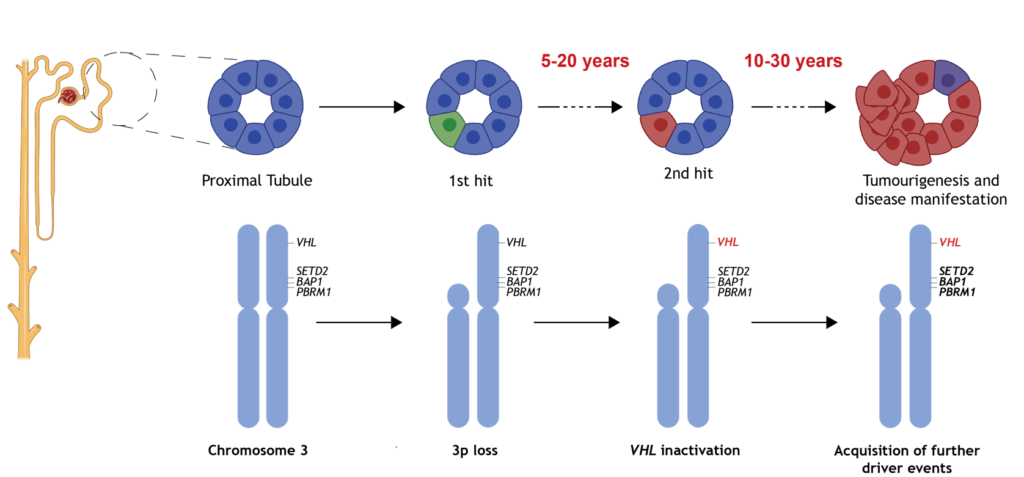
ccRCC initiation is defined by stereotyped genetic events in the proximal tubule epithelial cells of the kidney (1) (Figure 1), namely loss of chromosome 3p, followed by mutation or methylation of VHL, resulting in bi-allelic VHL loss. The rate at which these events occur and the likelihood that resulting small clonal expansions become fixed are unknown, as are the modifiable risk factors that influence promotion to cancer.
It is therefore critical to elucidate cell-intrinsic and extrinsic mechanisms that cooperate with obesity (and other modifiable risk factors) in the setting of 3p loss (1st hit) and VHL inactivation (2nd hit).
We hypothesise that obesity and other modifiable risk factors modulate the renal fitness landscape to favour cancer-promoting clonal dynamics.
This research study will achieve two major goals: 1) understand molecular mechanisms promoting ccRCC initiation in patients with obesity and metabolic syndrome; 2) identify and validate molecular vulnerabilities of the pre-malignant kidney to enable repurposing of existing therapeutics for disease prevention.
Collaborators
This project is a collaboration between The Cancer Research UK Manchester Institute, The Francis Crick Institute, and the MD Anderson Cancer Centre.
Colleagues include: Professor Samra Turajlić, Luigi Perelli, Omar Bouricha, Dr Haoyu Tang, Dr Angeliki Bania, Dr Naomi Van den Berg, Dr Martson Linehan, Dr Grace Farhat, Rose Woodward.