
Electronic Laboratory Notebooks
Electronic Laboratory Notebooks
An Institute-wide Electronic Lab Notebook
We have implemented an Institute-wide Electronic Lab Notebook (ELN) to support our research community in managing their data. Available to all Research Groups and Core Facilities since October 2025, researchers across the Institute are seeing the benefits of having a digital tool to record their experiments, share methods and capture data.
Electronic Lab Notebooks bring a number of advances over the more traditional hard-backed, handwritten lab book:
- They are digital-first, making it easier to include links to data repositories, images and videos
- Easy to organise and search by using Tags, Categories, or searching within text
- Supporting collaboration by sharing within Teams
- Access data from any Institute computer – including in the lab with in-lab tablets
- Providing tools for research integrity such as digital signatures and timestamps
These and other benefits have long been recognised, but a number of technical and cultural barriers have prevented the widespread adoption of ELNs in research settings. By working together across the Institute we have been able to address these barriers and provide access for all researchers to a tool which helps in day-to-day lab work and has long-term benefits for research.
Introducing the Institute's Electronic Lab Notebook
Following several years of testing, we chose an open-source Electronic Lab Notebook – eLabFTW – as our Institute ELN. This ELN is in use at universities around the world, and provides the flexibility we need for the diverse range of activities across the Institute. It allows for both structured and unstructured data entry – meaning researchers can create Templates to work step-by-step through a precise experimental plan while also recording their own notes and observations along the way.
eLabFTW is browser-based, so it can be accessed by any device able to connect to the Institute’s secure network. Access is managed by our IT and Scientific Computing Team, and all data is stored securely and with a thorough backup and data preservation plan.
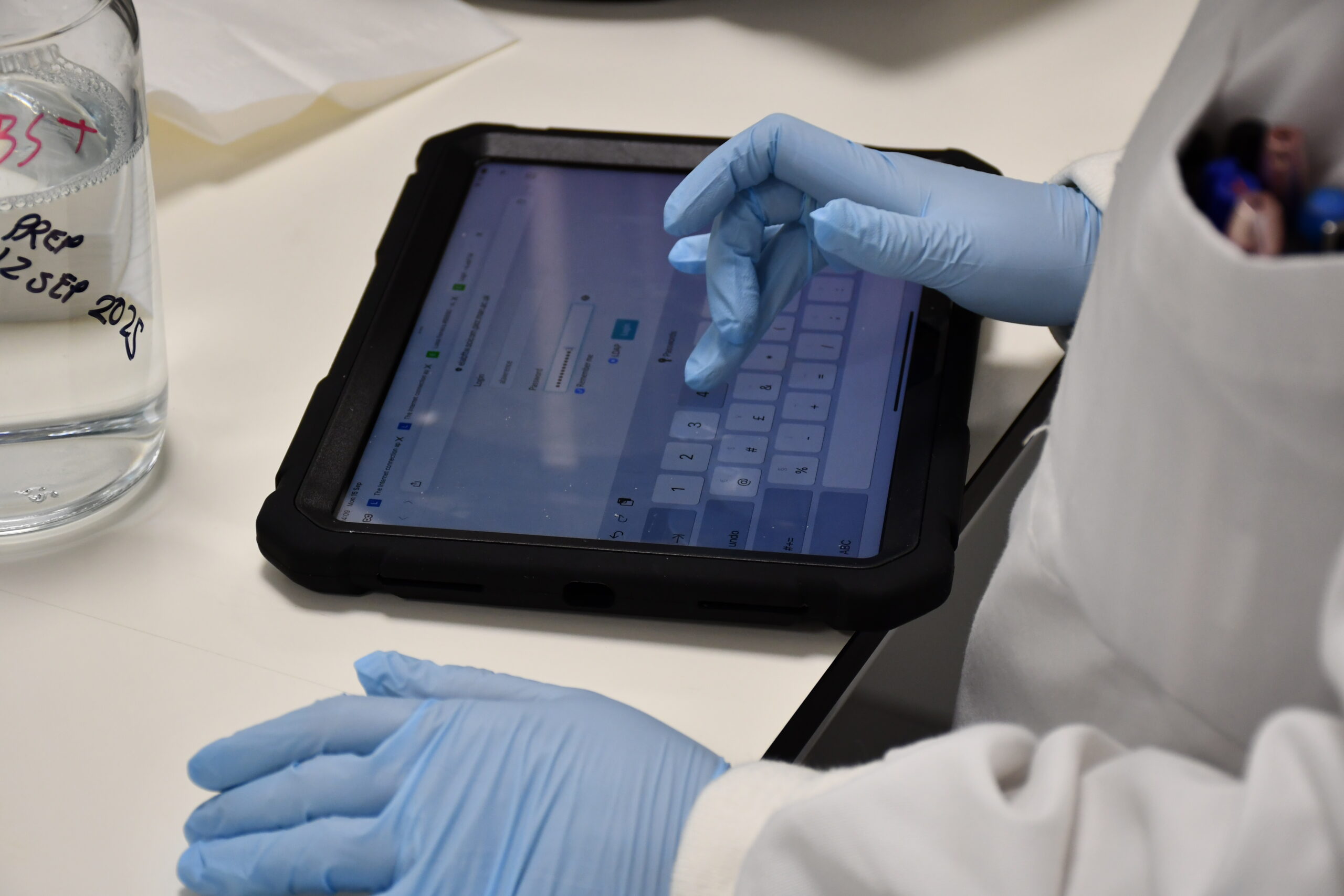
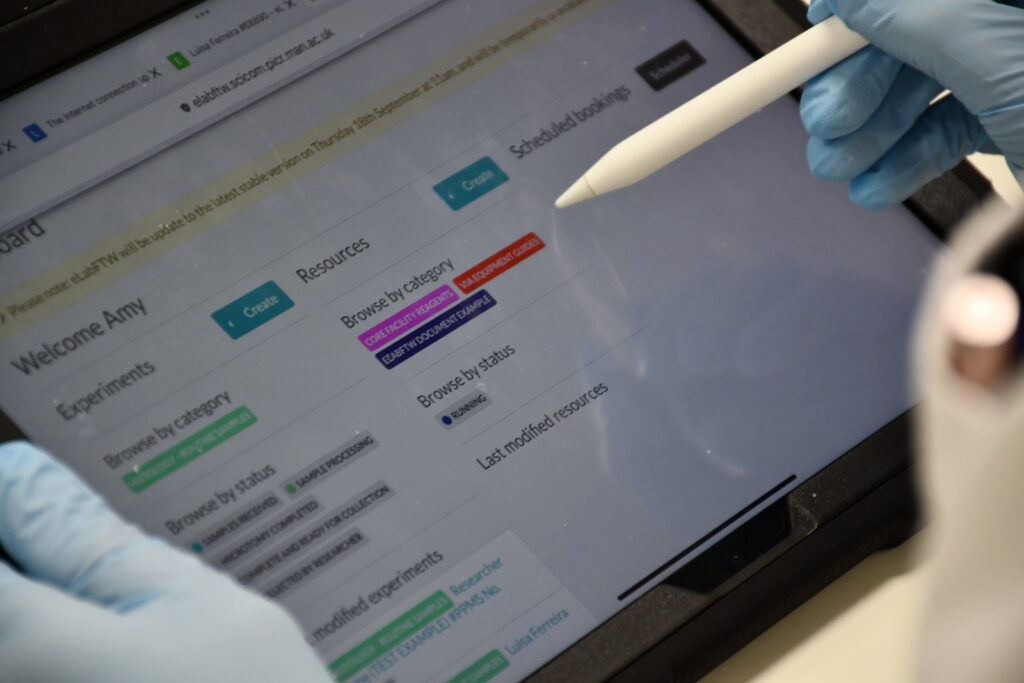
A common barrier to ELN use has been the lack of access to notes in the laboratories where experiments are happening. To overcome this, we have deployed in-lab tablets that are available to all Institute members in all lab spaces in the Paterson Building and the Oglesby Cancer Research Building.
Now,wherever researchers are working they can record their experiments, read methods, find reagents and keep track of their notes. All data captured on the tablets – including photographs or videos – is immediately and securely uploaded to Institute-managed servers. The tablets work while wearing gloves, and we have provided styluses which are useful for sketching and also can be used for handwriting-to-text note taking.
We provide training for all researchers using our centrally-managed, Institute-wide ELN. This includes inductions for new users and research groups, help with uploading and transferring data from other systems, and ongoing support in response to feedback and questions as people find new ways to apply the ELN to their work. We also have a support package from the company Deltablot who manage the ongoing development of eLabFTW. If you are interested in the development of the software, you can see all the progress on https://github.com/elabftw.
We are also engaging with other research organisations around the world who use eLabFTW through community events and online discussions, meaning that we are involved with shaping the further development of the software, as well as learning about how it has been applied in different research settings, such as the University of Heidelberg.
In addition, we are working with colleagues at the University of Manchester on a UKRI-funded Metascience Project on the implementation of ELNs, with the Manchester Institute as a case study with an ongoing evaluation of our rollout.
Here are some of the benefits of using the ELN that our research community have reported so far:
- Templates have helped standardise complex processes
- Research groups with complex protocols are now using standardised Templates to ensure all necessary information is captured at each step
- Our Visualisation, Irradiation and Analysis Core Facility have created Templates for all the microscopy platforms which include everything from setup instructions to recording instrument settings
- Histology Core Facility replaced multiple paper forms with a single ELN Template following tissue samples from embedding to fixation – all of which can be shared directly with researchers
- ELN use is supporting our sustainability goals by helping researchers find and reuse resources
- Replacing paper lab books for the ELN is helping our Mass Spectrometry Core Facility to access their notes whether in the lab or in the office
Further ELN Resources
If you are interested in finding out more about Electronic Laboratory Notebooks (sometimes also called Electronic Research Notebooks or Digital Notebooks), here are some resources we have found useful:
Considerations for implementing electronic laboratory notebooks in an academic research environment – A research paper from 2022 which provides a short history of ELNs, the current landscape and a case study of eLabFTW use
Electronic research and laboratory notebook dynamic purchasing system (DPS) – For organisations in the UK looking to implement an Electronic Research Notebook, JISC provide a set of resources to support procurement
Research Notebook Community – A community platform with examples of research notebook use across the UK
We have drawn on the experiences of an Electronic Lab Notebook trial at the University of Southampton, and you can read a report of that trial here