Article highlights & insights
Squamous cell carcinomas (SCCs) originate in epithelial tissues of older
individuals who have been exposed to environmental carcinogens. Despite
overlapping clinical hallmarks, SCCs from different anatomic sites have
different prognoses.
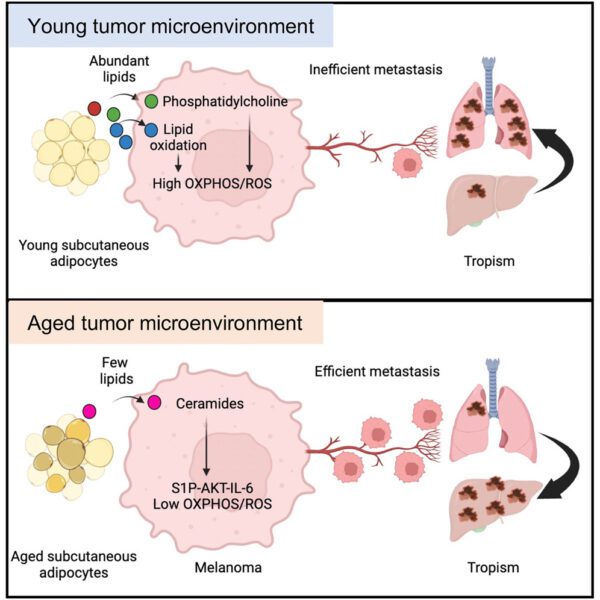
Here we show that fibroblasts confer site-specific cues that determine SCC proliferation and invasion. Oral and lung fibroblasts have distinct lipid metabolism, transferring unique lipids to SCC cells that promote epithelial-to-mesenchymal transition, and oral and lung SCC invasion. Whereas oral fibroblasts transfer sphingomyelins, which activate the ceramide–sphingosine-1-phosphate–STAT3 pathway and promote oral SCC invasion, lung fibroblasts transfer triglycerides to lung SCCs, thereby triggering cholesterol synthesis and invasion, which is associated with poor survival.
By contrast, dermal fibroblasts are lipid poor, and cutaneous SCC is less invasive. Our data indicate that targeting fibroblast lipid synthesis and SCC lipid uptake or breakdown inhibits oral and lung epithelial cancer invasion.
Squamous cell carcinomas (SCCs) originate in epithelial tissues of older
individuals who have been exposed to environmental carcinogens. Despite
overlapping clinical hallmarks, SCCs from different anatomic sites have
different prognoses.
Here we show that fibroblasts confer site-specific cues that determine SCC proliferation and invasion. Oral and lung fibroblasts have distinct lipid metabolism, transferring unique lipids to SCC cells that promote epithelial-to-mesenchymal transition, and oral and lung SCC invasion. Whereas oral fibroblasts transfer sphingomyelins, which activate the ceramide–sphingosine-1-phosphate–STAT3 pathway and promote oral SCC invasion, lung fibroblasts transfer triglycerides to lung SCCs, thereby triggering cholesterol synthesis and invasion, which is associated with poor survival.
By contrast, dermal fibroblasts are lipid poor, and cutaneous SCC is less invasive. Our data indicate that targeting fibroblast lipid synthesis and SCC lipid uptake or breakdown inhibits oral and lung epithelial cancer invasion.
Institute Authors
Groups
Group leader
https://royalsocietypublishing.org/rsob/article/16/8/260089/482862/CDK1-Cyclin-B-mediated-phosphorylation-of-PP2A-B56
CDK1-Cyclin B mediated phosphorylation of PP2A-B56 on B56Par1.T73T75 controls mitotic entry timing and Schizosaccharomyces pombe cell size
19 August 2026
Institute Authors (3)
Lenka Halova, Duncan Smith, Iain Hagan
Labs & Facilities
Biological Mass Spectrometry
Research Group
Cell Division
19 August 2026
https://www.cell.com/immunity/fulltext/S1074-7613(26)00278-5
CCR7+ activated dendritic cells are essential for spontaneous and immunotherapy-driven anti-tumor immunity
4 August 2026
Institute Authors (10)
Erin Richardson, Shih-Chieh Chiang, Massimo Russo, Charles Earnshaw, Anna Pidoux, Poppy Dunn, Sudhakar Sahoo, Antonia Banyard, Natalia Moncaut, Santiago Zelenay
Labs & Facilities
BRU Experimental Team, Computational Biology Support, Genome Editing and Mouse Models, Mass and Flow Cytometry, Transgenic Breeding Team
Research Group
Cancer Inflammation and Immunity
4 August 2026
https://www.cell.com/cell/fulltext/S0092-8674(26)00522-2
Plasma signals of lung tumor promotion for molecular cancer prevention
25 June 2026
Institute Authors (1)
William Hill
Research Group
Cancer Origins
25 June 2026
https://link.springer.com/article/10.1038/s44319-026-00809-1
PKMYT1 has an important role in the timing and fidelity of chromosome segregation
5 June 2026
Institute Authors (6)
Asma Belbelazi, Charlie Greenaway-Wells, Zoe Edwards, Wendy Trotter, Keren Dawson, Iain Hagan
Research Group
Cell Division
5 June 2026
https://www.nature.com/articles/s42255-026-01514-y
Tissue-specific fibroblast lipid cues impose the rate of epithelial cancer invasion
27 April 2026
Institute Authors (4)
Amaya Virós, Noah Palombo, Charlotte Russell, Claus Jørgensen
Research Group
Skin Cancer & Ageing
27 April 2026
https://www.cell.com/cancer-cell/fulltext/S1535-6108(26)00114-5
Immunometabolic gatekeeping: How tissue metabolism conditions tumor immunity
13 April 2026
Institute Authors (1)
Samra Turajlić
Research Group
Cancer Dynamics
13 April 2026