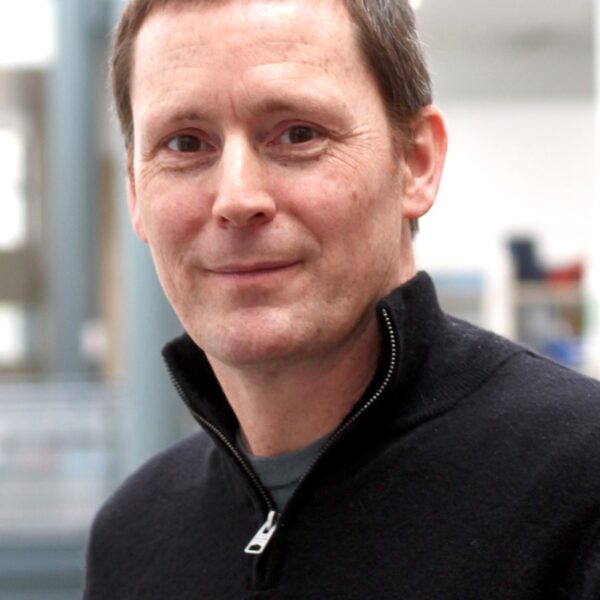
Magnus Rattray
Institute Affiliate
Magnus Rattray is Professor of Computational and Systems Biology at the University of Manchester, where his group develops novel computational, statistical and machine learning approaches for the analysis of spatial and single-cell omics, live cell and fixed imaging, and population health data. He is a Fellow of the European Laboratory for Learning and Intelligent Systems (ELLIS) and Director of ELLIS Unit Manchester. He is collaborating closely with CRUK Manchester Institute groups on data-driven approaches to cancer research and in 2026 he joined the CRUK Manchester Institute as affiliated faculty.
About Prof Magnus Rattray
Magnus Rattray began his academic career carrying out research at the interface of statistical physics, machine learning and bioinformatics while based in the University of Manchester’s Computer Science Department.
He was appointed Professor of Statistical Bioinformatics and Machine learning at the Sheffield Institute for Translational Neuroscience in 2010 before returning to the University of Manchester’s Faculty of Biology, Medicine and Health in 2012 as Professor of Computational and Systems Biology.
From 2016-25 he led the University’s AI strategy as Director of the University of Manchester Institute for Data Science and AI, contributing to a substantial growth in the University’s AI activity over the period, and establishing the successful and ongoing Advances in Data Science and AI annual conference.Over this period, he served as a Turing Fellow and was Manchester’s Turing University Lead, coordinating the University’s membership of the Turing Institute and associated research activities.
In 2019 he was appointed Fellow of the European Laboratory for Learning and Intelligent Systems (ELLIS) on the ELLIS Health Programme and from 2020-24 he was co-president of the Machine Learning for Computational Systems Biology (MLCSB) COSI of the International Society for Computational Biology (ISCB), coordinating the most popular COSI session of the major international bioinformatics conference ISMB. He is founding Director of ELLIS Unit Manchester (from 2021) which fosters links with leading European machine learning researchers through international PhD student exchanges and hosting of popular events such as Manchester’s ELLIS Summer School in Machine Learning for Healthcare and Biology.
Magnus Rattray’s current research is focuses on the development of modern machine learning approaches for dealing with large-scale datasets from omics and imaging technologies. His group’s research is supported by major awards from the Wellcome Trust and UKRI. He leads the computational modelling on a Wellcome Trust Discovery Award that aims to uncover the mechanisms underlying gene expression dynamics during early embryonic development.
He also leads the Generative Biology working group of the £12M EPSRC AI-hub on Generative Models, bringing together researchers from seven institutions across the UK to develop cutting-edge Generative AI technology. He is a co-leader of the data pillar of the £25M MRC Centre of Research Excellence in Exposome Biology, and major centre between the Universities of Manchester and Oxford that seeks to uncover the immunological mechanisms that mediate the effects of environmental exposures on inflammatory disease.
He has collaborated closely with colleagues at the CRUK Manchester Institute over the last decade and hopes to deepen these links over the next few years, using data-driven approaches to uncover the mechanisms underlying cancer initiation, progression and treatment.
Interests
- Computational Biology
- Machine Learning
- Single-cell and spatial omics
- Multimodal integration
Why I work at CRUK MI
“The CRUK Manchester Institute stands out as a leading environment to transform cutting-edge basic research into real breakthroughs for cancer patients. “
Featured publications
Daw, R. H., Deijnen, H. R., Rattray, M., & Grainger, J. R. (2026).
CellTypeAI: Automated cell identification for scRNA-seq using local generative-AI. Proceedings of ECCB 2026, Bioinformatics, in press.
Isik, E. B., Haley, M. J., Anbaki, A. A., Bere, L., Roncaroli, F., Piper Hanley, K., … & Rattray, M. (2026).
Proteomics-constrained deconvolution reveals spatial cell-type programs in tumours. bioRxiv, 2026-06.
Phuycharoen, M., Kaestele, V., Williams, T., Lin, L., Hussell, T., Grainger, J., & Rattray, M. (2026).
Integration of unpaired and heterogeneous clinical flow cytometry data. Iscience, 29(3).
Georgaka, S., Morgans, W. G., Zhao, Q., Martinez, D. S., Ali, A., Ghafoor, M., … & Rattray, M. (2025).
CellPie: a scalable spatial transcriptomics factor discovery method via joint non-negative matrix factorization. Nucleic acids research, 53(6), gkaf251.
Get in touch
All Institute Publications
https://www.sciencedirect.com/science/article/pii/S2666634026003387?via%3Dihub
Bacteria inside kidney tumors associate with myeloid inflammation and disease progression: A TRACERx Renal study
23 October 2026
Institute Authors (1)
Samra Turajlić
Research Group
Cancer Dynamics
23 October 2026
https://royalsocietypublishing.org/rsob/article/16/8/260089/482862/CDK1-Cyclin-B-mediated-phosphorylation-of-PP2A-B56
CDK1-Cyclin B mediated phosphorylation of PP2A-B56 on B56Par1.T73T75 controls mitotic entry timing and Schizosaccharomyces pombe cell size
19 August 2026
Institute Authors (3)
Lenka Halova, Duncan Smith, Iain Hagan
Labs & Facilities
Biological Mass Spectrometry
Research Group
Cell Division
19 August 2026
https://www.cell.com/immunity/fulltext/S1074-7613(26)00278-5
CCR7+ activated dendritic cells are essential for spontaneous and immunotherapy-driven anti-tumor immunity
4 August 2026
Institute Authors (10)
Erin Richardson, Shih-Chieh Chiang, Massimo Russo, Charles Earnshaw, Anna Pidoux, Poppy Dunn, Sudhakar Sahoo, Antonia Banyard, Natalia Moncaut, Santiago Zelenay
Labs & Facilities
BRU Experimental Team, Computational Biology Support, Genome Editing and Mouse Models, Mass and Flow Cytometry, Transgenic Breeding Team
Research Group
Cancer Inflammation and Immunity
4 August 2026
https://www.cell.com/cell/fulltext/S0092-8674(26)00522-2
Plasma signals of lung tumor promotion for molecular cancer prevention
25 June 2026
Institute Authors (1)
William Hill
Research Group
Cancer Origins
25 June 2026
https://link.springer.com/article/10.1038/s44319-026-00809-1
PKMYT1 has an important role in the timing and fidelity of chromosome segregation
5 June 2026
Institute Authors (6)
Asma Belbelazi, Charlie Greenaway-Wells, Zoe Edwards, Wendy Trotter, Keren Dawson, Iain Hagan
Research Group
Cell Division
5 June 2026
https://www.nature.com/articles/s42255-026-01514-y
Tissue-specific fibroblast lipid cues impose the rate of epithelial cancer invasion
27 April 2026
Institute Authors (4)
Amaya Virós, Noah Palombo, Charlotte Russell, Claus Jørgensen
Research Group
Skin Cancer & Ageing
27 April 2026
Our vision for world leading cancer research in the heart of Manchester
We are a leading cancer research institute within The University of Manchester, spanning the whole spectrum of cancer research – from investigating the molecular and cellular basis of cancer, to translational research and the development of therapeutics.


Our collaborations
Bringing together internationally renowned scientists and clinicians


Scientific Advisory Board
Supported by an international Scientific Advisory Board